
The Diamond Disc Difference
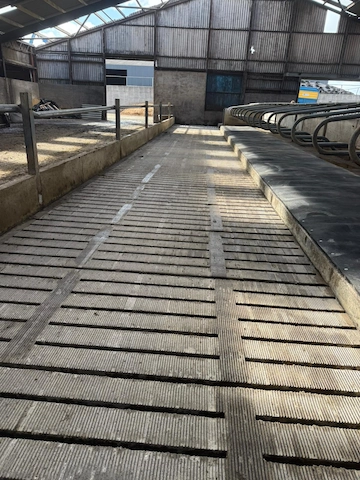
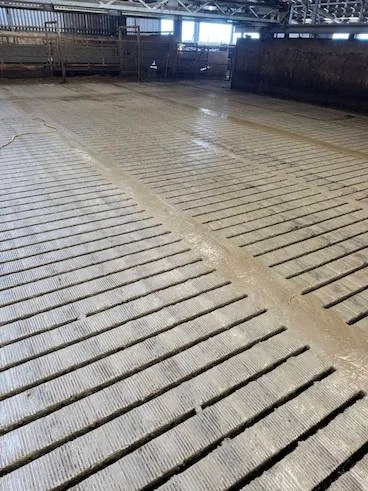
Not all grooving is the same. Diamond Disc technology cuts a clean 90° shelf into the concrete — the kind that lasts 5–10 years, not 12–18 months.
Get a Free Quote
Serving Dumfries & Galloway, Cumbria, Ayrshire and the Scottish Borders.
Call Ryan: 07708 523 765Every few months, someone rings me to ask: should I fit rubber mats or get the yard grooved? It's a fair question. And unlike a lot of things in farming, there's actually a clear answer.
I've walked into farms where someone has spent thousands on rubber matting. I know what happened to them. I've also grooved yards that were transformed overnight. So let me give you the honest version — not a sales pitch, just what I've seen with my own eyes across hundreds of farms in Scotland and Cumbria.
The Case for Rubber Mats
I'm not going to pretend rubber mats are a bad idea across the board. On paper, they make sense for certain areas. They add cushioning. They reduce hoof wear on hard concrete. For cubicle passages and loafing areas — where cows stand for long periods — the softer surface genuinely reduces leg fatigue and white line disease risk.
The problem isn't what rubber mats do when they're new. The problem is what happens after two or three years on a busy dairy unit.
Where Rubber Mats Let You Down
In high-traffic areas — collecting yards, races, exit passages from the parlour — rubber mats wear fast. The textured surface that gripped when they were new? Gone. You're back to a smooth surface, except now it's rubber instead of concrete. You've spent more and ended up in the same place.
Then there's the hygiene problem. Rubber mats trap muck and moisture underneath. I've lifted mats on farms and found conditions I wouldn't want to describe. The concrete below hadn't been properly cleaned in years. Digital dermatitis loves that kind of environment — warm, wet, airless. If you're fighting DD and you've got rubber mats on a wet floor, that's worth thinking about.
And cost? Good-quality rubber matting for a collecting yard runs three to five times the price of concrete grooving. When it wears out — and it will — you're paying again. That's before you factor in the time and disruption of lifting, cleaning underneath, and re-laying.
"Rubber mats on a collecting yard are a plaster. Grooving is the cure. Get the floor right and the rest follows."
What Concrete Grooving Actually Does
Concrete grooving doesn't cushion the hoof. That's not its job. Its job is to give the cow's hoof a ledge to push against when she's walking, turning, or being pushed by the cows behind her in the collecting yard.
The grip is mechanical. The groove edge acts as a shelf — when the hoof moves sideways or backwards, it catches on the groove wall and the cow doesn't slip. A cow that trusts the floor moves differently. She walks confidently to the parlour, stands properly at the feed fence, shows heat. A nervous cow on a slippery floor loses 20% of her milk yield. That's not opinion, that's what slippery floors do to production.
Because the grooves are open channels — not covered by rubber — they stay clean. Slurry scrapers clear them. Sunlight reaches them. The surface stays hygienic.
Why the Method Matters — Not Just the Idea of Grooving
Here's where most farmers get let down, and where I have to be straight with you.
Wire-cut grooving wears smooth in 12–18 months. The wire drags across the surface rather than cutting it cleanly, which means the groove edges round off quickly under cattle traffic. You might as well have fitted rubber mats for the lifespan you'll get.
Scabbling — flail machines — shatters the concrete surface. It's better than nothing, but the jagged finish rounds off and the broken surface can damage hooves. I've trimmed cows on farms that had flail grooving done two years ago, and you'd barely know it was there.
Diamond Disc machines are different. The blade saws a clean, 90-degree channel into the concrete. That square edge is what creates the grip — the shelf for the hoof to lock against. And because the disc saws rather than hammers, the concrete around the groove isn't fractured. The structure stays intact. The edge stays sharp.
I've done Diamond Disc jobs that are still performing after eight or nine years. I have farms I grooved once and never needed to go back to. That's the difference in the method, not just the idea.
The Honest Comparison
| Rubber Mats | Wire-Cut Grooving | Diamond Disc Grooving | |
|---|---|---|---|
| Lifespan | 2–4 years | 12–18 months | 5–10 years |
| Upfront cost | High | Low–Medium | Medium |
| Hygiene | Poor — traps muck underneath | Good | Excellent — clean open channels |
| Hoof health | Good for cubicles; DD risk on wet floors | Basic grip | Grip + clean environment |
| Best use | Cubicle passages, loafing areas | Short-term fix | Collecting yards, races, all high-traffic areas |
My Recommendation
Use both — strategically.
Rubber matting in cubicles and loafing areas makes sense where cushioning matters. Diamond Disc grooving on collecting yards, passages, races, and anything with heavy foot traffic. That combination gives you the best of both: hoof comfort where cows rest, confident grip where cows move.
What I'd steer away from is rubber mats on collecting yards or any area with constant movement. They don't last. They create hygiene problems. And they give you a false sense of security — the cows are still at risk, you just can't see it as easily.
If your yard is slippery, the problem is the concrete surface. Grooving fixes that at the source. Laying rubber on top of a smooth floor is a patch, not a solution. Sort the floor and the rest follows.
Ring me on 07708 523765 and I'll tell you honestly whether your yard needs grooving or whether you're better off with mats in a particular area. I'd rather give you the right advice than take a job that doesn't need doing.