
Method at a Glance
Wire-Cut
Wears smooth in 12–18 months
Carbide Wheels / Scabbling
Hammers and fractures the surface
Diamond Disc
Clean 90° cut. Lasts 5–10+ years.
Get a Free Quote
Dumfries & Galloway, Cumbria, Ayrshire and the Scottish Borders.
Call Ryan: 07708 523 765If you're getting quotes for concrete grooving, you'll probably get three different methods quoted at three different prices. Here's what those methods actually do — and why the cheapest one will cost you more in the long run.
I've grooved hundreds of yards across Scotland and Cumbria. I've also gone back to farms where someone else did the job first, and I can show you exactly what different methods look like after two years of cattle traffic. The difference isn't subtle.
Method One: Wire-Cut Grooving
Wire-cut machines drag a rotating wire across the surface of the concrete. It's fast, it's cheap, and for the first few months it works well enough that you might not notice the problem.
The issue is the groove profile. The wire creates a rounded channel — a U-shape rather than a square cut. That rounded edge is the grip. And a rounded edge wears down quickly. Under the constant pressure and abrasion of cattle hooves, slurry, and scrapers, the edge rounds off further until you're left with a shallow, smooth-sided channel that provides almost no traction.
Typical lifespan on a busy dairy unit: 12–18 months. Which means you're paying for the job again in two years, or living with a slippery yard.
Method Two: Carbide Wheels and Scabbling
Carbide wheel machines and scabbling (flail) machines both work on the same principle: impact. They hammer, chip, or drag hardened carbide or steel tips across the concrete surface to roughen it up.
Fresh off the machine, a scabbled yard looks grippy. It's rough. You run your hand across it and think: that'll do. And in the short term, it does. Carbide wheel grooving cuts a more defined channel than scabbling, and some of the larger national operators use this method — it's faster to cover ground with.
The problem with both is the same: the surface is fractured, not cut. The hammering action sends vibration through the concrete. The channels and surface texture are created by breaking the material away, not by slicing through it cleanly. That fractured surface wears faster than intact concrete. The edges aren't square — they're jagged and uneven. Over time, the cattle hooves and scrapers erode the raised texture and you're back where you started.
There's also a structural risk on slatted sheds. The vibration from a carbide or flail machine can crack slats — a £50–£150 repair bill per slat before you count labour or downtime. I won't use these methods on slats for that reason.
"The groove edge is the grip. A rounded edge wears away. A square edge doesn't."
Method Three: Diamond Disc
A Diamond Disc machine uses a rotating blade embedded with industrial diamonds to saw through the concrete. Not hammer it, not drag a wire across it — saw it. The same principle as a tile cutter or a concrete saw on a building site.
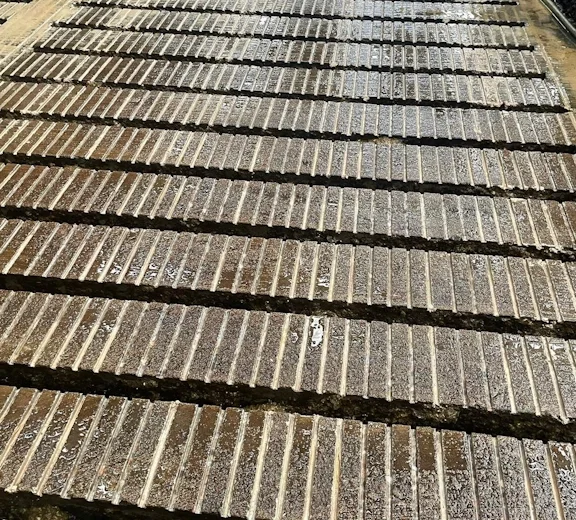
What you get is a clean, 90-degree channel. The walls of the groove are smooth and intact. The edge at the top — the part the hoof pushes against — is square and sharp. It isn't tapered. It isn't rounded. It's a shelf.
That square edge is the whole point. When a cow's hoof moves sideways or backwards on a smooth floor, there's nothing to stop it sliding. When there's a square groove edge every 60mm or so, the hoof catches against it. The cow feels the grip. She walks differently. She stops hesitating at the parlour entrance. She doesn't avoid the collecting yard.
Because the concrete around the groove is uncut and undamaged, it stays hard and dense. The edge doesn't erode. I've revisited jobs eight or nine years later and the grooves are still performing. That doesn't happen with wire-cut or carbide.
The Physics, Simply Put
Think of it like a stair edge versus a ramp. A ramp gives you a gradual surface to slide down. A stair edge gives you something to catch your foot against.
Wire-cut and worn carbide grooves are ramps. Diamond Disc grooves are stair edges. The cow's hoof loads against that vertical face and can't slide past it. The grip is real and it stays real because the edge doesn't change shape over time.
The Cost Comparison Over Time
| Wire-Cut | Carbide / Scabbling | Diamond Disc | |
|---|---|---|---|
| Groove profile | Rounded U-shape | Jagged, uneven | Clean 90° square cut |
| Concrete damage | Minimal | Fractures surface | None — clean saw cut |
| Typical lifespan | 12–18 months | 2–3 years | 5–10+ years |
| Safe for slats | Risky | No — vibration risk | Yes — zero vibration |
| 10-year cost (re-grooves) | 5–7 jobs | 3–4 jobs | 1 job |
| Hygiene | Adequate | Rough surface traps muck | Excellent — clean open channels |
Why I Made the Choice I Did
When I started R.C. Adamson, I could have bought cheaper equipment and quoted cheaper jobs. Wire-cut machines are less expensive. You can cover more ground faster with carbide. The margins look better on paper.
But I was trained by my father — 30 years as a hoof trimmer, spending his career watching what bad floors do to cattle. He understood that the floor and the foot are connected. A job that wears out in eighteen months isn't a job, it's a delay.
I wanted to do work I could stand behind. The kind where I go back to a farm five years later and the farmer says the yard is still grippy. That doesn't happen with wire-cut. It does happen with Diamond Disc, reliably.
If you're getting multiple quotes, ask each contractor what method they use and what the expected lifespan is. Then compare the cost per year, not the cost per job. The answer usually becomes clear.